
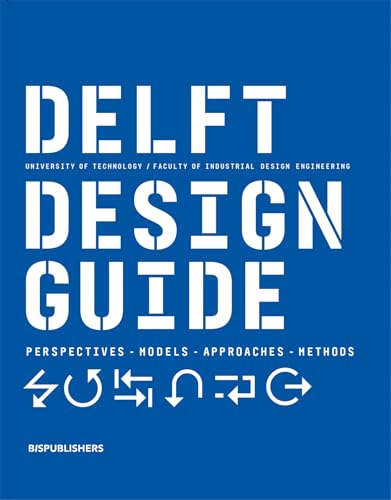
Delft design guide : perspectives, models, approaches, methods / Delft University of Technology, Faculty of Industrial Design Engineering ; editors, Annemiek van Boeijen, Jaap Daalhuizen, Jelle Zijlstra.
Material type: TextPublisher: Amsterdam, The Netherlands : BIS Publishers, 2020Copyright date: ©2013Edition: Revised editionDescription: 223 pages : illustrations (some color) ; 26 cmISBN:
 - 9789063695408
- TS171 .D44 2020
| Item type | Current library | Call number | Copy number | Status | Date due | Barcode | |
|---|---|---|---|---|---|---|---|
| Book | TBS Barcelona | TS171 DEL (Browse shelf(Opens below)) | 1 | Available | B05932 |
Browsing TBS Barcelona shelves Close shelf browser (Hides shelf browser)

|

|

|

|

|

|

|
||
| TS155 STE Operations management | TS155 STE Operations management | TS155 STE Operations management | TS171 DEL Delft design guide : perspectives, models, approaches, methods | TS171.4 HOW How to do EcoDesign? : a guide for environmentally and economically sound design | TS171.4 NOR The design of everyday things | TS176 FOG Production and inventory management |
Includes bibliographical references and index.
PERSPECTIVES
— Design for Health & Wellbeing
— Design for Sustainability
— Design for Behavioural Change
— Design for Emotion
— Design for the Majority
— Culture-Sensitive Design
— Speculative Design
— More-Than-Human Design
— Skilful Co-design
— Visualising Interactions
— Design Drawing as a Language
— MODELS
— Reasoning in Design
— Basic Design Cycle
— Product Innovation Process
— Agile Design & Development
— Integrated Creative Problem Solving
— Needs and Aspirations for Design & Innovation
— APPROACHES
— User-Centred Design
— Social Implication Design
— Co-design & Co-creation
— Anthropometric Design
— Vision in (Product) Design
— Context Variation by Design
— Service Design
— Persuasive Game Design
— Lean Start-up
— Material Driven Design
— Data-Centric Design
— Design Roadmapping
— METHODS: DISCOVER
— Contextmapping
— Thing Ethnography
— Cultural Probes
— User Observations
— Interviews
— Questionnaires
— Focus Groups
— Ecodesign Strategy Wheel
— Ecodesign Checklist
— Fast Track Life Cycle Analysis
— SWOT & Search Areas
— Trend Foresight
— Brand DNA
— WWWWWH
— Design Drawing to Discover
METHODS: DEFINE
— Persona
— Cultura
— Problem Definition
— Function Analysis
— Product Life Cycle
— List of Requirements
— Mind Mapping
— Journey Mapping
— Product Journey Mapping
— Project Value Modelling
— Business Modelling
— Sustainable Business Modelling
— Future Visioning
— Ansoff Growth Matrix
— Segmentation-Targeting-Positioning
— VRIO Analysis
— Porter’s Five Forces
— Perceptual Map
— Collage
— Storyboarding
— Written Scenario
— Design Drawing to Define
— METHODS: DEVELOP & DELIVER
— Analogies & Metaphors
— Biomimicry
— Synectics
— Brainstorming & Brainwriting
— Braindrawing
— Morphological Chart
— SCAMPER
— How-Tos
— Harris Profile
— EVR Decision Matrix
— C-Box
— vALUe, IR & PMI
— Datum Method
— Weighted Objectives
— Storytelling
— Usage Analytics
— Comfort Evaluation
— PrEmo & Photo-Elicitation
— Role-Playing
— Product Usability Evaluation
— Product Concept Evaluation
— Cost Price Estimation
— Prototype Reflection Cards
— Cinematic Prototyping
— Design Drawing to Develop
— Experience Prototyping
— Wizard of Oz
— Design Drawing to Deliver
— 3D Physical Models
— Technical Documentation.
Delft Design Guide provides an overview of the perspectives, models, approaches, and methods used in the bachelor's and master's curriculum of Industrial Design Engineering at Delft University of Technology (TU Delft). Some of these are unique to the university, others are well known and are used by designers worldwide. Designing products and services at this faculty is considered a systematic and structured activity, deliberately and purposefully, and with moments of increased creativity.
The methods and techniques are each described in a practical one-page text, illustrated for further clarification and enriched with images that should encourage reflection and further reading.
Design students can use the book as a reference guide in their design projects and in managing their personal development. Design teachers can use the book as a reference guide to assist students in learning a method. Design professionals can use the book as a reference guide to support their design processes.
