
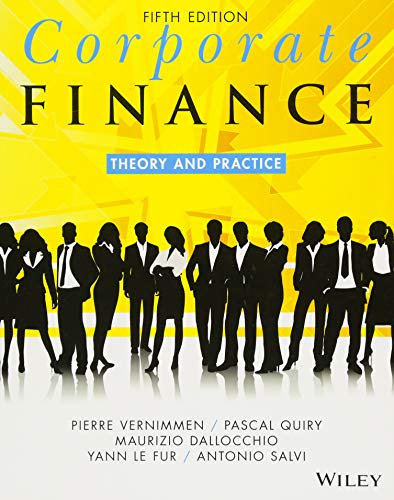
Corporate finance : theory and practice / Pierre Vernimmen, Pascal Quiry, Maurizio Dallocchio, Yann Le Fur, Antonio Salvi.
Material type: TextPublisher: Hoboken : Wiley, 2017Edition: Fifth editionDescription: 1024 pagesISBN:
 - 9781119424482
- HG4026 .V467 2017
| Item type | Current library | Call number | Copy number | Status | Date due | Barcode | |
|---|---|---|---|---|---|---|---|
| Book | TBS Barcelona | HG4026 VER (Browse shelf(Opens below)) | 1 | Available | B06023 | ||
| Book | TBS Barcelona | HG4026 VER (Browse shelf(Opens below)) | 2 | Available | B05611 | ||
| Book | TBS Barcelona | HG4026 VER (Browse shelf(Opens below)) | 3 | Available | B05610 | ||
| Book | TBS Barcelona | HG4026 VER (Browse shelf(Opens below)) | 4 | Available | B05609 |
Browsing TBS Barcelona shelves Close shelf browser (Hides shelf browser)

|
|

|
|
|

|

|
||
| HG4026 VER Corporate finance : theory and practice. | HG4026 VER Corporate finance : theory and practice. | HG4026 VER Corporate finance : theory and practice | HG4026 VER Corporate finance : theory and practice | HG4026 VER Corporate finance : theory and practice | HG4027.5 EIT Multinational business finance | HG4027.5 SHA Multinational financial management (2020, 11 ed.) |
What is Corporate Finance?
—
Section I: Financial Analysis
—
Part One: Fundamental Concepts in Financial Analysis
—
Cash Flow
—
Earnings
—
Capital Employed and Invested Capital
—
Walking Through from Earnings to Cash Flow
—
Getting to Grips with Consolidated Accounts
—
How to Cope with the Most Complex Points in Financial Accounts
—
Part Two: Financial Analysis and Forecasting
—
How to Perform a Financial Analysis
—
Margin Analysis: Structure
—
Margin Analysis: Risks
—
Working Capital and Capital Expenditures
—
Financing
—
Return on Capital Employed and Return on Equity
—
Conclusion and Financial Analysis
—
Section II: Investors and Markets
—
Part One: Investment Decision Rules
—
The Financial Markets
—
The Time Value of Money and Net Present Value
—
The Internal Rate of Return
—
Part Two: The Risk of Securities and the Required Rate of Return
—
Risk and Return
—
The Required Rate of Return
—
Part Three: Financial Securities
—
Bonds
—
Other Debt Products
—
Shares
—
Options
—
Hybrid Securities
—
Selling Securities
—
Section III: Value
—
Value and Corporate Finance
—
Measuring Value Creation
—
Investment Criteria
—
The Cost of Capital
—
Risk and Investment Analysis
—
Valuation Techniques
—
Section IV: Corporate Financial Policies
—
Part One: Capital Structure Policies
—
Capital Structure and the Theory of Perfect Capital Markets
—
Capital Structure, Taxes and Organisation Theories
—
Debt, Equity and Options Theory
—
Working Out Details: The Design of the Capital Structure
—
Part Two: Equity Capital
—
Returning Cash to Shareholders
—
Distribution in Practice: Dividends and Share Buy-Backs
—
Share Issues
—
Part Three: Debt Capital
—
Implementing a Debt Policy
—
Section V: Financial Management
—
Part One: Corporate Governance and Financial Engineering
—
Setting Up a Company or Financing Start-Ups
—
Choice of Corporate Structure
—
Initial Public Offerings (IPOs)
—
Corporate Governance
—
Taking Control of a Company
—
Mergers and Demergers
—
Leveraged Buyouts (LBOs)
—
Bankruptcy and Restructuring
—
Part Two: Managing Working Capital, Cash Flows, Financial Risks and Real Estate
—
Managing Working Capital
—
Cash Management
—
Managing Financial Risks
—
Managing Operational Real Estate
—
Epilogue – Finance and Strategy
—
Top 20 Largest Listed Companies.
Corporate Finance has long been a favourite among both students and professionals in the field for its unique blend of theory and practice with a truly global perspective. The fact that the authors are well-known academics and professionals in the world of mergers and acquisitions (M&A) and investment explains this popularity. This new Fifth Edition continues the tradition, offering a comprehensive tour of the field through scenario-based instruction that places concept and application in parallel. A new chapter has been added, devoted to the financial management of operating buildings that aims to answer questions such as, “to own or to rent?” “variable or fixed rents?” etc. The book’s companion website features regularly updated statistics, graphs and charts, along with study aids including quizzes, case studies, articles, lecture notes and computer models, reflecting the author team’s deep commitment to facilitating well-rounded knowledge of corporate finance topics. In addition, a monthly free newsletter keeps the readers updated on the latest developments in corporate finance as well as the book’s Facebook page, which publishes a post daily.
Financial concepts can be quite complex, but a familiar setting eases understanding while immediate application promotes retention over simple memorisation. As comprehensive, relevant skills are the goal, this book blends academic and industry perspective with the latest regulatory and practical developments to provide a complete corporate finance education with real-world applicability.
Blend theory and practice to gain a more relevant understanding of corporate finance concepts —
Explore the field from a truly European perspective for a more global knowledge base —
Learn essential concepts, tools and techniques by delving into real-world applications —
Access up-to-date data, plus quizzes, case studies, lecture notes and more.
A good financial manager must be able to analyse a company’s economic, financial and strategic situation, and then value it, all while mastering the conceptual underpinnings of all decisions involved. By emphasising the ways in which concepts impact and relate to real-world situations, Corporate Finance provides exceptional preparation for working productively and effectively in the field. Provided by publisher.
