
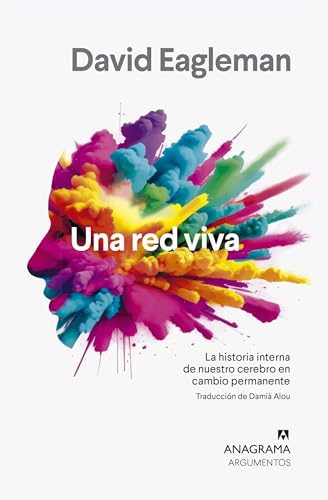
Una red viva : la historia interna de nuestro cerebro en cambio permanente / David Eagleman; traducción de Damiá Alou
Material type: TextLanguage: Spanish Original language: English Series: Argumentos ; 600Publisher: Barcelona : Editorial Anagrama, 2024Publisher: 2024 Edition: First editionDescription: 414 pages: illustrations ; 22 cmISBN:
 - 9788433921949
- Livewired. Spanish
| Item type | Current library | Call number | Copy number | Status | Notes | Date due | Barcode | |
|---|---|---|---|---|---|---|---|---|
| Book | TBS Barcelona | QP376 EAG (Browse shelf(Opens below)) | 1 | Available | WELL COLLECTION | B06008 |
Browsing TBS Barcelona shelves Close shelf browser (Hides shelf browser)

|

|

|

|

|

|

|
||
| QP376 CLA Simply the brain | QP376.C37 CAS El espejo del cerebro : neurociencia y meditación | QP376 DIN Tu cerebro al descubierto : lo que la neurociencia nos revela sobre el cerebro y sus rarezas | QP376 EAG Una red viva : la historia interna de nuestro cerebro en cambio permanente | QP376 MAR ¿Dónde están las llaves? | QP376 POW The DOSE effect | QP376 RIC Brain : an owner's guide |
Un fascinante viaje a la infinita capacidad de aprendizaje, remodelación y autorregeneración del cerebro.
El cerebro y sus misterios, el cerebro y sus maravillas. David Eagleman, prestigioso neurocientífico y profesor de la Universidad de Stanford, nos ofrece en este libro una nueva exploración sobre este órgano: un recorrido fascinante en torno a la plasticidad del cerebro, capaz de mudar para adaptarse a condiciones cambiantes.
Expone, por ejemplo, el caso de un niño al que deben extirparle la mitad del cerebro y se comprueba cómo la mitad restante se reconfigura para amoldarse a la nueva situación. O el caso del cerebro de las personas ciegas, que se adecua a esta limitación y potencia los otros sentidos. O el de las personas con una prótesis a cuya presencia se acomoda el cerebro. La actividad cerebral se reacondiciona de forma permanente para afrontar nuevas circunstancias y nuevos aprendizajes.
Con la ya contrastada capacidad del autor para explicar de manera clara y apasionante el complejo mapa cerebral, este libro presenta casos históricos (como el del miembro fantasma del almirante Nelson) y contemporáneos, y explica experimentos punteros que nos hablan de los últimos avances en la ciencia del cerebro. Incluso se adentra en el futuro, con los sorprendentes progresos en las conexiones entre cerebro y robótica.
A fascinating journey into the brain’s remarkable capacity for learning, adaptation, and self-renewal.
The brain and its mysteries, the brain and its wonders. In this compelling book, renowned neuroscientist and Stanford University professor David Eagleman offers a fresh exploration of the brain: a captivating journey through its astonishing plasticity—the ability to reshape itself in response to changing conditions.
He presents cases such as that of a child who undergoes the removal of half his brain, only for the remaining half to reorganise and take over the lost functions. Or the case of blind individuals whose brains adapt by enhancing other senses. Or those with prosthetic limbs, whose brains adjust to incorporate these artificial extensions. The brain, Eagleman explains, continuously reconditions itself to meet new challenges and learn anew.
With his well-known gift for making complex science clear and enthralling, Eagleman draws on both historical examples—such as Admiral Nelson’s phantom limb—and cutting-edge research, revealing the latest breakthroughs in neuroscience. He even looks ahead to the future, where surprising advances in brain–machine interfaces promise to transform our understanding of what the brain can do.
