
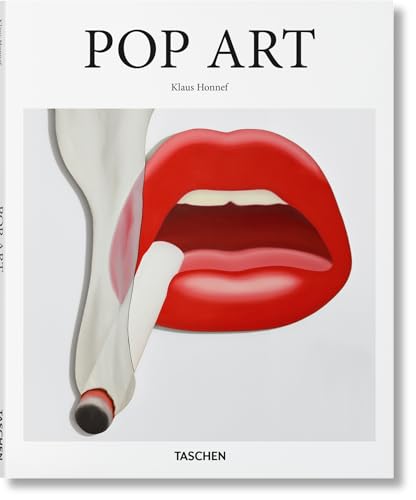
Pop art / Klaus Honnef ; edited by Uta Grosenick ; translated by Mariona Gratacòs.
Material type: TextLanguage: Spanish Original language: German Series: Basic art series 2.0Publication details: Cologne : Taschen, 2015.Description: 95 pages : illustrations (some color) ; 27 cmISBN:
 - 9783836506007
- N6494 .P6 H6618 2004
| Item type | Current library | Call number | Copy number | Status | Date due | Barcode | |
|---|---|---|---|---|---|---|---|
| Book | TBS Barcelona | N6494.P6 KLA (Browse shelf(Opens below)) | 1 | Available | B05905 |
Alcanzando su apogeo en la década de 1960, el Arte Pop comenzó como una revuelta contra los enfoques tradicionales del arte y la cultura, y evolucionó hacia una interrogación total de la sociedad moderna, la cultura del consumo y el papel del artista y la obra de arte. Centrándose en temas como el materialismo, la celebridad y los medios de comunicación, el Arte Pop se inspiró en fuentes del mercado masivo, desde la publicidad y los cómics hasta las caras más famosas de Hollywood y los empaques de productos de consumo, estos últimos ejemplificados por las latas de sopa Campbell de Andy Warhol. Además de desafiar al establecimiento al elevar imágenes populares, banales y kitsch, el Arte Pop también adoptó métodos de producción en masa, reduciendo el papel del artista individual mediante técnicas mecanizadas como la serigrafía. Con artistas destacados como Andy Warhol, Allan Jones, Ed Ruscha, Robert Indiana, Jasper Johns, Robert Rauschenberg y Roy Lichtenstein, este libro presenta todo el alcance e influencia de un movimiento modernista definitorio.
Peaking in the 1960s, Pop Art began as a revolt against mainstream approaches to art and culture and evolved into a wholesale interrogation of modern society, consumer culture, and the role of the artist and artwork. Focusing on issues of materialism, celebrity, and media, Pop Art drew on mass-market sources, from advertising imagery to comic books, from Hollywood's most famous faces to the packaging of consumer products, the latter epitomized by Andy Warhol's Campbell's soup cans. As well as challenging the establishment with the elevation of such popular, banal, and kitschy images, Pop Art also deployed methods of mass-production, reducing the role of the individual artist with mechanized techniques such as screen printing. With featured artists including Andy Warhol, Allan Jones, Ed Ruscha, Robert Indiana, Jasper Johns, Robert Rauschenberg, and Roy Lichtenstein, this book introduces the full reach and influence of a defining modernist movement.
