
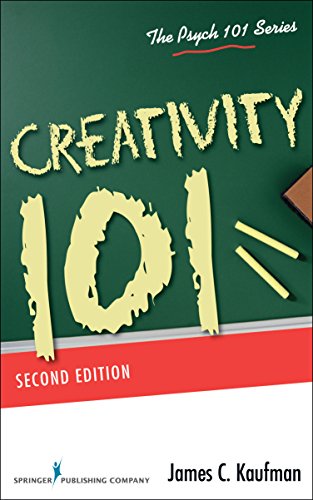
Creativity 101 / James C. Kaufman, PhD.
Material type: TextLanguage: English Series: Psych 101 seriesPublication details: New York : Springer Publishing Company, [2016]Edition: Second editionDescription: xvi, 349 p. ; 21 cmISBN:
 - 0826129528
- 9780826129529
- Creativity one hundred one
- BF408 .K364 2016
| Item type | Current library | Call number | Copy number | Status | Notes | Date due | Barcode | |
|---|---|---|---|---|---|---|---|---|
| Book | TBS Barcelona | 1 | Available | SOON AVAILABLE |
Includes bibliographical references and index.
Part I: The Basics — What Is Creativity? — Theories of Creativity — The Structure of Creativity — Measures of Creativity — Part II: The Creative Individual — Creativity and Personality — Creativity and Motivation — Creativity and Intelligence — Creativity and Mental Health — Part III: The Big Picture — Creativity and Admissions, Hiring, and Fairness — Creative Environments: Life, Classrooms, Workplaces, and the World — Creative Perceptions (of Self and Others) — Is Creativity a Good Thing or a Bad Thing? — Epilogue: The Future of Creativity.
What makes us creative? How can organizations, schools, or parents inspire people to be more creative? How do we even start to define the topic in thefirst place? Now in its second edition, this bestselling introductory text—written by one of the world’s leading experts on the psychology of creativity—iscompletely updated and expanded to reflect the tremendous growth in this field. In a restructured, reader-friendly format, the text surveys the latesttheories and research to provide key information about what we know (and don’t know) about creativity. It addresses how creativity operates both onindividual and on social/environmental levels, how it is defined and measured, and several hot debates in the field, such as creativity’s uncertainrelationship to mental illness. Grounded in psychological research from clinical, industrial, social, cognitive, evolutionary, and developmentalperspectives, this text also draws on classic and current findings from neuroscience, business, education, engineering, and biology.
This much-praised book is an ideal brief and affordable text for courses on creativity in psychology, education, business, and other fields, as well ascross-disciplinary seminars and programs in creativity studies.
